
Why Study Singing Bowls?
- Jan 9
- 3 min read

Singing bowls are often discussed as objects: their materials, their frequencies, their cultural origins, or their perceived effects on listeners. In parallel, they have been frequently studied in isolation of its physics, removing the human element and variation. What is far less commonly examined is how physical properties with human technique, and systems of representation interact to produce stable, controllable, and reproducible sound.
This research begins from the premise that a singing bowl is not a passive resonator but part of a coupled human–instrument system. Sound does not arise from the bowl alone, nor from the player alone, but from the interaction between bowl geometry, excitation method, fine motor control, and the symbolic systems used to describe and transmit that interaction. Without studying these elements together, key aspects of singing bowl performance remain poorly understood.
The Gap in Existing Research
Acoustic research has provided valuable insights into singing bowls, particularly regarding modal vibrations, frequency spectra, and resonance behaviour. However, these bodies of work rarely intersect in a way that allows systematic comparison, repeatability, or methodological transfer; knowledge about technique, context, and use has been missing.
As a result, several foundational questions remain unresolved:
Why do identical bowls behave differently in different hands?
Which aspects of technique matter most for tonal stability and control?
How do physical constraints shape what techniques are even possible?
Why is singing bowl knowledge so difficult to notate, teach, or reproduce consistently?
These are not questions that can be answered by physics alone, nor by experiential practice in isolation. They arise precisely at the boundary where material constraints meet embodied control.
Singing Bowls as Coupled Systems
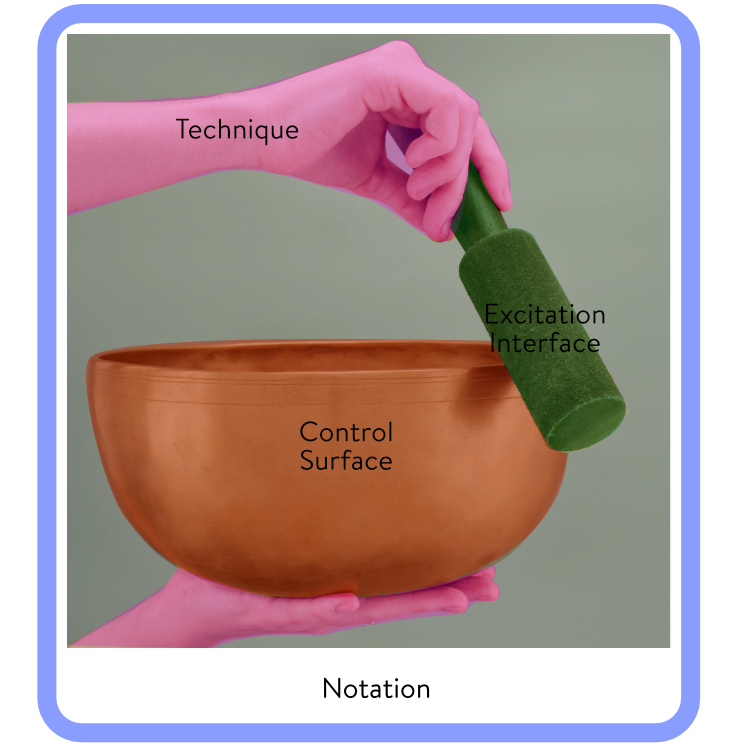
To address this gap, this research frames singing bowl performance as a dynamic system composed of interdependent components:
Physical constraints (bowl geometry, mass, alloy, rim profile)
Human control variables (pressure, speed, angle, motor stability)
Excitation interfaces (mallet material, surface texture, compliance)
Representation systems (notation, diagrams, symbolic scores)
Each component both enables and limits the others. Changes in mallet material alter which techniques are viable. Bowl geometry constrains achievable excitation regimes. Human motor control adapts in response to both. Notation systems, in turn, determine which aspects of this interaction can be communicated or preserved.
By studying these elements together, the focus shifts away from isolated descriptions toward relationships, dependencies, and feedback loops, the hallmark of system-based inquiry.
Why This Matters
Without a system-level understanding, singing bowl practice remains difficult to analyse, difficult to teach, and difficult to reproduce. Performers rely heavily on intuition, while researchers struggle to describe technique in ways that can be meaningfully tested or compared. This limits both artistic development and scientific investigation.
A clearer framework has practical implications:
For performers, it enables more precise control and intentional sound design.
For researchers, it supports repeatable experimental conditions.
For educators, it allows technique to be transmitted without relying solely on imitation.
For notation, it opens the possibility of scores that describe process rather than fixed outcomes.
Ultimately, this approach treats singing bowls not as static objects nor mystical black boxes, but as structured, learnable, and researchable systems grounded in both physics and embodied practice.
From Problem to Research Questions
The research questions that follow emerge directly from this framing. Rather than asking what a singing bowl is, they ask how singing bowls behave within a system; how stability arises, how control is achieved, and how knowledge can be represented across players and contexts.
Read More At: Research Questions


Comments